Soil depletion: why food doesn't nourish like it used to
Take an apple from 1950 and an apple from today. They look the same. They taste about the same. But they aren't the same.
Today's apple contains significantly fewer minerals than one from seventy years ago. The apple hasn't changed, but the soil has.
Intensive farming, monocultures, synthetic fertilizers. Decades of soil being worked harder and harder while receiving less and less in return. The result is soil depletion. Crops still grow. They look healthy. But the minerals they used to naturally absorb from the soil? They simply aren't there anymore.
What used to be normal is now exceptional.
Whole grains, vegetables, and fruit still provide calories. Often vitamins, too. But the trace elements needed to make those nutrients work at a cellular level? They are increasingly missing.
You can't see it. But you can feel it.

Mineral deficiency: signs you probably recognize
Minerals aren't just a bonus. They are essential building blocks.
Your heart, brain, muscles, immune system, skin, and hormones—they all rely on minerals. Without the right minerals, in the right amounts, in the right places, your body's infrastructure gradually breaks down.
Your body needs 72 of them. Most people only know three.
And then there are dozens of other trace elements your body needs every day. In small amounts. Sometimes in traces so small they are barely measurable. But indispensable. Germanium. Rubidium. Strontium. Nickel. Tin. Titanium. Names you won't find on the supplement shelf. But which are present in healthy soil. And have functions in your body that scientists are still busy unraveling.
Your body needs 72 of them. The soil once provided them all. It does so less and less.
Your body cannot produce these substances itself. They must come entirely from outside sources. Through food. Through the soil in which that food was grown.
No minerals in the soil means no minerals in your food. Which means no minerals in your body. That chain is direct.
You can't see a deficiency in magnesium, zinc, selenium, or iron on an X-ray. You feel it.
Common signs of a deficiency:
- Persistent fatigue, even after enough sleep
- Concentration problems, "brain fog"
- Muscle cramps or restless legs
- Slower recovery after exercise
- An immune system that falters more easily
- Irritability with no clear cause
The problem: these symptoms are common. A GP can rarely trace them directly to a single deficiency. Blood tests often only measure extremes, not the creeping lower limits where most people live.
So what do you do? You don't feel well. You look for a supplement. You feel a temporary improvement, or nothing at all. You look for another supplement.
This leads to a cupboard full of pills and a stack of supplements. And a head full of doubt. But what if the problem isn't what you're looking for?
Supplements and absorption: why taking more doesn't mean absorbing more
The problem is rarely the supplement itself. It’s the absorption.
By absorption, we mean: what your body actually takes in and uses. Not what is on the label. But what enters your bloodstream through your intestinal wall and reaches your cells from there.
Imagine a package delivered to your door that is never opened. It is there, but it does nothing.
It works the same way with minerals. Your body can only use a mineral if it can pass through the cell wall.
Many minerals in standard supplements are in a form that the body struggles to recognize and transport. A portion of what you take simply leaves your body again. Unused.
Intake is not absorption
It is the difference between doing something and achieving something.
That distinction explains why people who do everything right still feel like something is missing. They are taking in enough. But what their body actually absorbs is a different story.
The absorption rate and efficiency of minerals vary greatly depending on their form. Magnesium oxide has a different bioavailability than magnesium bisglycinate. Iron sulfate works differently than iron bound to amino acids. The form determines not only how much you absorb, but also whether you experience gastrointestinal issues along the way.
What your body recognizes best are minerals in an organic, natural form. Just as they occur in nature. In healthy soil. In living organic matter.
Fulvic acid: what it is, how it is formed, and why it works
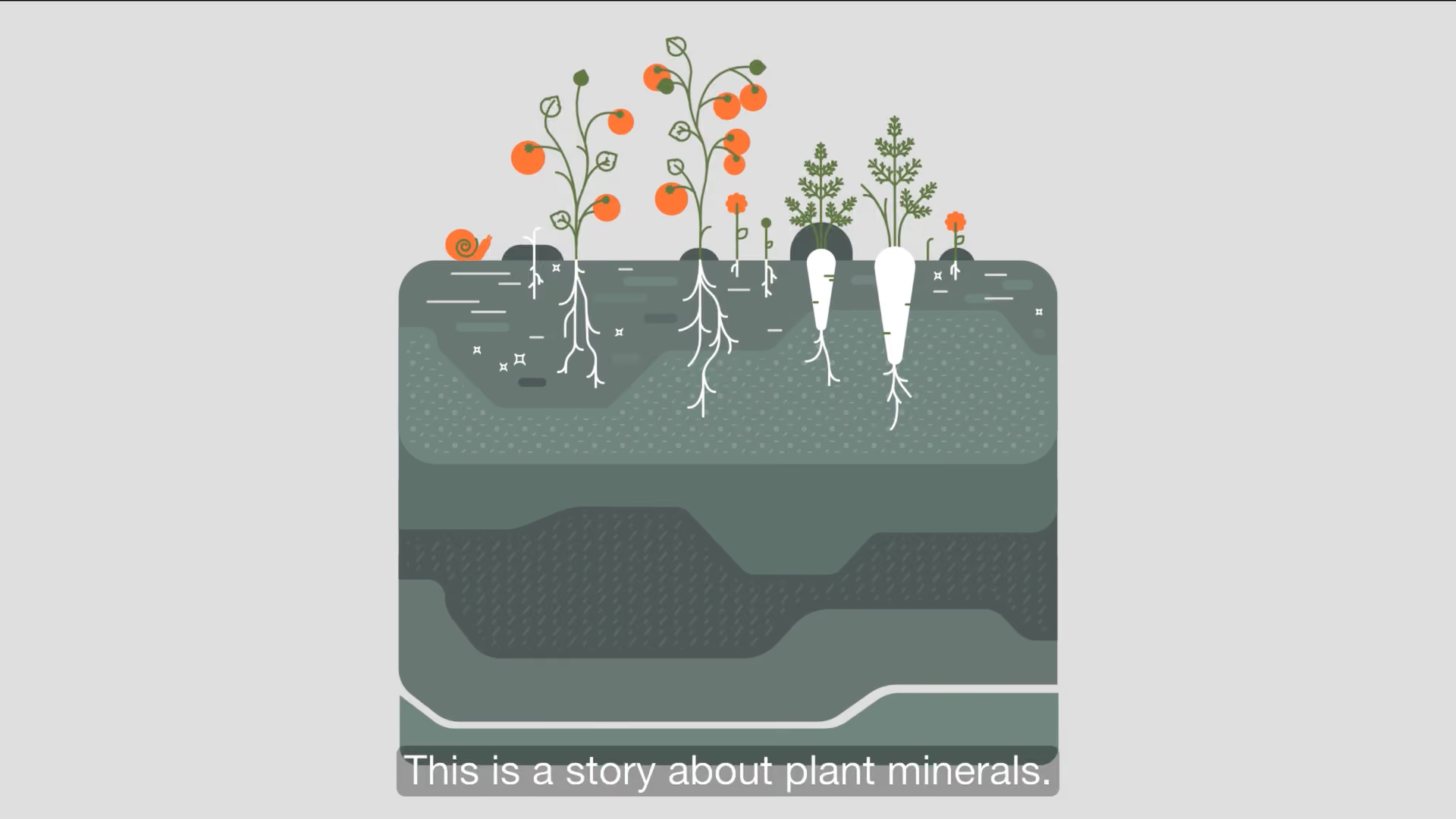
Fulvic acid is a natural substance. It is formed during the slow decomposition of organic matter in living, healthy soil. Plants, leaves, roots—everything that breaks down in the ground. That process takes centuries. The result is a complex molecule with a unique property: it binds to minerals and helps them pass through cell walls.
Fulvic acid is not a mineral itself. It is the carrier. Think of it as a key that fits a lock that would otherwise remain closed.
How it works
Fulvic acid has an exceptionally low molecular weight. This allows it to pass through cell walls that remain closed to most other molecules. It binds to minerals, making them recognizable and transportable for the body. Not as a synthetic construct, but in the form the body has recognized minerals for millions of years.
It works on three levels:
- Binding — fulvic acid binds to minerals in an organic, bioavailable form.
- Transport — it helps move those minerals through cell walls, right down to the cellular level.
- Exchange — it supports the exchange of substances into and out of the cell.
Fulvic acid occurs naturally in healthy soil. But due to soil depletion, intensive farming, and the disappearance of organic soil matter, it is increasingly absent from our diet. What used to be ingested through a carrot or an apple is now barely present.
Plant-based minerals: what they are and why they work differently
Not all minerals are created equal.
There is a fundamental difference between minerals from a factory and minerals from a plant. Inorganic minerals, as found in many cheap supplements, are extracted directly from earth layers or ores. The body does not recognize them as well. Absorption is lower. The chance of unused residues is higher. That is why you also have to be careful with dosages.
Plant-based minerals are different. They have been filtered by living organic matter. By plants, roots, fungi, and bacteria in healthy soil. This biological processing makes them water-soluble, organically bound, and recognizable to the human body.
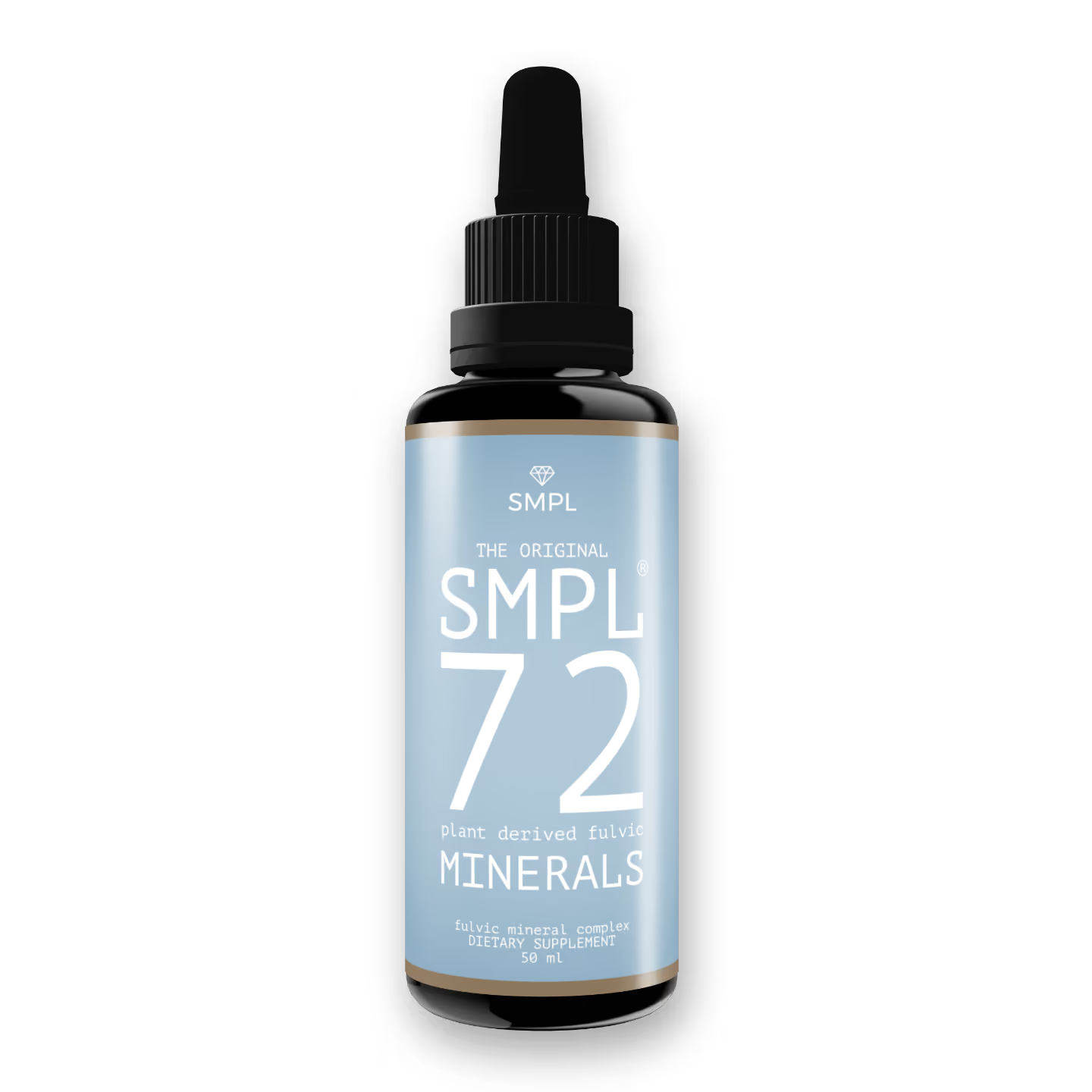
SMPL72 contains fulvic acid that is naturally bound to 72 minerals and trace elements. This bond was not created synthetically. It formed in the soil itself, over millions of years, in pristine layers of earth that have never been exposed to modern agriculture.
That is the difference. Not what is in it. But how it is in it.
Applications: what do people use SMPL72 for?
SMPL72 works on the foundation. The base upon which everything rests. People use it for a variety of reasons, but there are patterns.
Persistent fatigue
People who have been tired for years, despite getting enough sleep, eating a healthy diet, and exercising regularly. Those who have tried everything. And who discover that the foundation—mineral absorption—was the bottleneck.
Support for an active lifestyle
Exertion increases the demand for minerals. Magnesium, potassium, and zinc are lost more quickly during sweating and recovery. SMPL72 supports the absorption of what the body needs most during those moments.
Complementary to existing supplements
Many people use SMPL72 as a foundation alongside their existing supplements. Because the question isn't which supplements you take, but whether they actually reach where they need to go. Many people find they can stop taking individual mineral bottles.
Focus and mental clarity
Minerals play a direct role in nerve conduction and brain function. Magnesium, zinc, iodine—deficiencies often manifest as brain fog, forgetfulness, or difficulty focusing. Not a quick fix. But a foundation that was missing.
General maintenance
For those who don't see health as a project, but as maintenance. Who aren't looking for optimization, but for a foundation that works. One choice. No further explanation needed.
Science: what research says about fulvic acid and mineral absorption
What is known
On fulvic acid
Fulvic acid is a humic acid, a class of organic compounds that has been studied for decades in agricultural and soil science. Research shows that fulvic acid can increase the bioavailability of trace elements by forming stable, easily absorbable complexes with mineral ions. The structure of the molecule—low molecular weight, high charge density, and multiple functional groups—makes it exceptionally well-suited as a carrier for minerals.
Fulvic acid has been studied less extensively in human research than in agricultural contexts, but the available studies are promising.
Research published in journals such as the Journal of Alzheimer's Disease and Phytotherapy Research points to potential effects on inflammation, cognition, and cellular energy production. The mechanism identified for this is consistent: the role of fulvic acid as an electron donor and acceptor at the cellular level.
On mineral absorption and bioavailability
Mineral absorption is highly dependent on their chemical form. Organically bound minerals—chelates, amino acid complexes, or forms bound by fulvic acid—generally have higher bioavailability than inorganic salts. This has been extensively documented for magnesium, zinc, and iron, among others.
On soil depletion and nutritional value
Studies by the University of Texas, the British Food Standards Agency, and others show a significant decline in the mineral content of fruits and vegetables over the past seven decades. For iron, magnesium, and zinc, declines of 20 to 70 percent have been reported, depending on the crop and the measurement method.