{ "@context": "https://schema.org", "@graph": [ { "@type": "BlogPosting", "headline": "What is the difference between minerals, trace elements, and ultratrace elements?", "description": "Minerals, trace elements, and micronutrients exist in various forms and quantities. These essential substances are crucial for our bodies and the natural world.", "url": "https://www.smpl.international/artikelen/wat-is-het-verschil-tussen-mineralen-sporen-en-spoorelementen", "inLanguage": "nl", "author": { "@type": "Person", "name": "Maarten Bennis", "sameAs": https://www.linkedin.com/in/maartenbennis/}, "datePublished": "2024-05-08T12:09:35.000Z", "dateModified": "2024-11-07T14:28:59.000Z", "image": "https://cdn.prod.website-files.com/6a8063f2f177d9c5bb5ffded/6aa93c048d63d8e68b35c414_6675b087bef5c23441477504_All-the-Minerals-in-the-World-main.avif", "publisher": { "@id": "https://www.smpl.international/#organization" }, "articleSection": "Minerals" }, { "@type": "BreadcrumbList", "itemListElement": [ { "@type": "ListItem", "position": 1, "name": "Home", "item": "https://www.smpl.international/" }, { "@type": "ListItem", "position": 2, "name": "Artikelen", "item": "https://www.smpl.international/artikelen" }, { "@type": "ListItem", "position": 3, "name": "What is the difference between minerals, trace elements, and ultratrace elements?" } ] } ] }
90-day money-back guarantee
Free shipping
Ordered before 4 PM = delivered tomorrow
Minerals

What is the difference between minerals, trace elements, and ultratrace elements?

Minerals, trace elements, and micronutrients exist in various forms and quantities. These essential substances are crucial for our bodies and the natural world.

What is the difference between minerals, trace elements, and ultratrace elements?

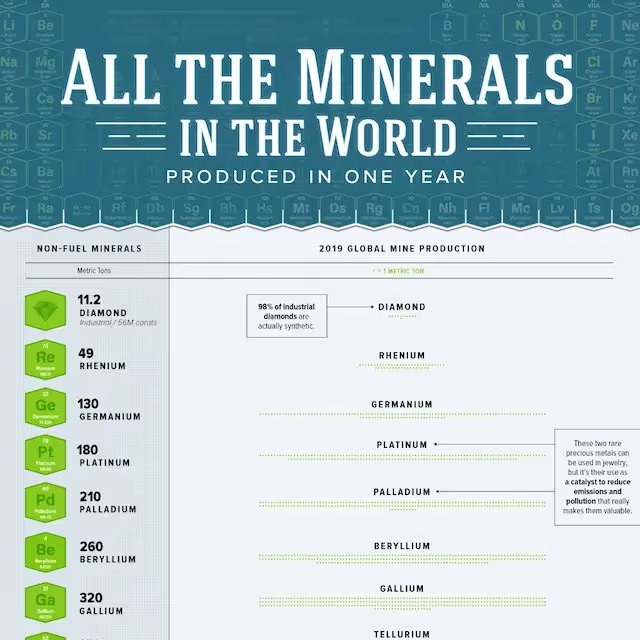
You can find the infographic above at Visual Capitalist. (Spoiler: sand is by far the most extracted material).

I always find infographics fascinating, especially when they’re about minerals. While studying the one mentioned above, I realized that we use the term "minerals" in different ways, each with a different meaning. It’s confusing, so I thought I’d clarify it.

When we talk about minerals, we are actually referring to the elements as they appear in the periodic table. In a previous article I discussed this in detail. However, elements don't always occur in nature in their pure form. Very often, their atoms are bonded to atoms of other elements (such as oxygen, also known as oxides). These compounds that occur naturally (in the Earth's crust) are officially called minerals.

Using chemical techniques, you can refine these minerals into a single element.

But what about the minerals I see at mineral shows? Those are unique pieces of stone or rock found in nature. If you saw one of these stones in half, you’ll see the unique crystal structure for which it is named.

When we talk about mineral nutrients, we use the terms minerals, trace elements, and micronutrients. The main difference lies in the amount present in the body. Minerals are the most abundant, followed by trace elements, and finally micronutrients, which are only present in very small amounts.

In summary:

  • Minerals occur freely in nature, usually in the form of stony material, crystals, or salts.
  • Minerals are composed of various molecules that can arrange themselves into crystal structures.
  • Molecules consist of atoms.
  • Molecules that consist of only one type of atom are also called elements.
  • All naturally occurring elements, plus a few that can only be created in laboratories, can be found in the so-called 'periodic table'.
  • The difference between minerals, trace elements, and ultratrace elements lies in the amounts in which they are present in the human body.
Waar dit op gebaseerd is

No items found.

Frequently asked questions

Everything you want to know about SMPL72, enrollment, and how it works. Still have questions? We've got the answers.

Go to all questions

How quickly will I notice the effects of fulvic acid?

This varies from person to person and depends primarily on your starting point. Fulvic acid supports the absorption and bioavailability of the minerals you already get through your diet or supplements. The faster your body responds to that improved availability, the sooner you will notice a difference. People with low mineral levels or higher requirements often experience changes sooner than those who are already well-nourished. Some users notice more clarity or a calmer energy level within a few days, while for others, it happens more gradually over a period of weeks. In SMPL72, the fulvic acid is naturally bound to 72 different minerals and trace elements. The most important thing is consistency: fulvic acid doesn't act as a quick stimulant, but as a daily absorption mechanism that builds its effect step by step.

I already take supplements for zinc and magnesium deficiencies. Why should I take SMPL72?

People often get some minerals from various sources, but usually not enough. Furthermore, they are often poorly absorbed by the digestive system. It is important to realize that most supplements are synthetic, and in the case of minerals, they are essentially just rock. These contain large molecules that your body can barely absorb, if at all. We have previously written a blog post about the ins and outs of supplementation; feel free to check out our blog section. You might already be taking magnesium or zinc, but keep in mind that you are only taking one or two of the 60 minerals your body needs every day. When you think in terms of a complementary approach, you cannot simply pick one mineral out of the entire spectrum.‍

Does fulvic acid help with fatigue or brain fog?

Fulvic acid is not an energy booster, nor is it a substance that provides an immediate effect on fatigue or concentration. What it does is something more fundamental: it supports the way your body absorbs and utilizes minerals. And that very point—the utilization of minerals—plays a bigger role for many people than they realize. Fatigue, "brain fog," and concentration issues often have multiple causes, but in orthomolecular practice, it is frequently observed that mineral metabolism and electrolyte balance are significant factors. Minerals are necessary for processes such as: - signal transmission in the nervous system - energy production in the mitochondria - oxygen transport - fluid balance in and around the cell - enzyme activity involved in focus, alertness, and metabolism If those minerals are insufficiently available at the cellular level, the body cannot perform these processes efficiently. Fulvic acid cannot solve that on its own, but it makes minerals chemically smaller, more soluble, and more accessible to the body. As a result, the minerals you ingest through food or supplements can be better utilized where they are needed. Many users experience a more stable energy level, greater clarity, or fewer fluctuations throughout the day. Not because fulvic acid provides a direct stimulant, but because minerals are able to do their job better. This is a fundamentally different mechanism than that of caffeine, stimulants, or "energy boosters." It remains important to emphasize: fulvic acid is not a treatment for fatigue or concentration issues. It merely supports the biological foundation upon which energy, clarity, and nerve function operate. What an individual notices from it naturally also depends on diet, hydration, lifestyle, and individual needs.

What does fulvic acid taste like and what is the best way to take it?

Fulvic acid has a very mild, almost neutral taste. Most people barely notice it when they add a few drops to a glass of water. Some describe it as having a very light mineral flavor, but you usually only notice it if you are really paying attention. SMPL72 is pure fulvic acid with no additives, which keeps the taste soft, clean, and subtle. You don't need to worry about a bitter, sharp, or "muddy" taste, which is common in impure or thick humic products.‍Most users find that it simply tastes like water with a very faint hint of minerality. This makes it easy to use every day, even for children or people who are sensitive to strong flavors. It is best to take SMPL fulvic acid in a glass of chlorine-free water. Fruit juice is also an option, but avoid hot drinks. It is very easy to use.

How should I use SMPL72?

Add 7-10 drops daily to a glass of (chlorine-free) water (fruit juice is also an option, but avoid hot drinks). For children: 1 drop per 10 kg of body weight. Feel free to increase the dose during illness or intense physical exertion. For maximum absorption: take 30 minutes before a meal. For an energetic start to the day: take in the morning on an empty stomach. For recovery: take immediately after sports or physical exertion. SMPL72 is a powerful detox, so be sure to drink plenty of water. If you are pregnant or taking medication, build up the dose gradually and monitor how your body reacts. When in doubt, consult your doctor or midwife.

Cookie preferences
By clicking "Accept all", you agree to the storing of cookies on your device to enhance site navigation, analyze site usage, and assist in our marketing efforts, as described in our privacy policy.
Necessary (always active)
Cookies that are necessary to enable the basic functionality of the website.
Cookies used to understand how the website is performing and whether there are any potential technical issues.
Cookies used to display advertisements that are relevant to your interests.
Cookies that allow the website to remember choices you make (such as your username, language, or the region you are in).