Soil
Soil depletion and mineral deficiency: what you need to know
Mineral deficiency due to depleted soil? Discover what soil depletion means for nutrition, minerals, and your health.
Mineral deficiency due to depleted soil? Discover what soil depletion means for nutrition, minerals, and your health.
What you eat may not be as healthy as you think. While you assume you are getting enough vitamins and minerals every day, something shocking is happening right under our noses: the soil in which our food grows is being depleted of essential minerals. This means the nutritional value of our fruits and vegetables is dropping dramatically. But that’s not all; this silent crisis could have far-reaching consequences for our health and our survival. In this blog, we expose how serious this problem is, what it means for you, and how we can tackle this threat before it’s too late.
Minerals are essential building blocks for life. They play a crucial role in numerous biological processes, including enzymatic reactions, bone formation, nerve function, and maintaining a strong immune system. Without an adequate intake of these minerals, these processes cannot function optimally, leading to a wide range of health problems and complaints. Your body cannot produce minerals itself. You must obtain them from external sources, through food and water. If the soil in which your food grows contains fewer minerals, it can ultimately affect the nutritional value of what you eat.
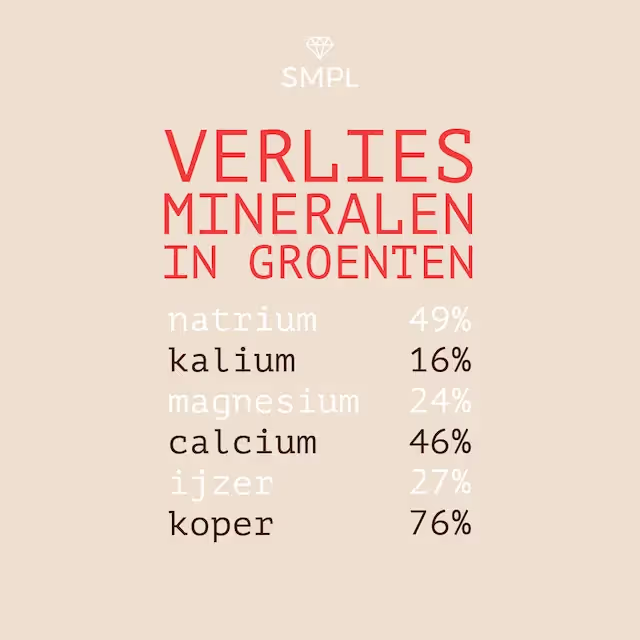
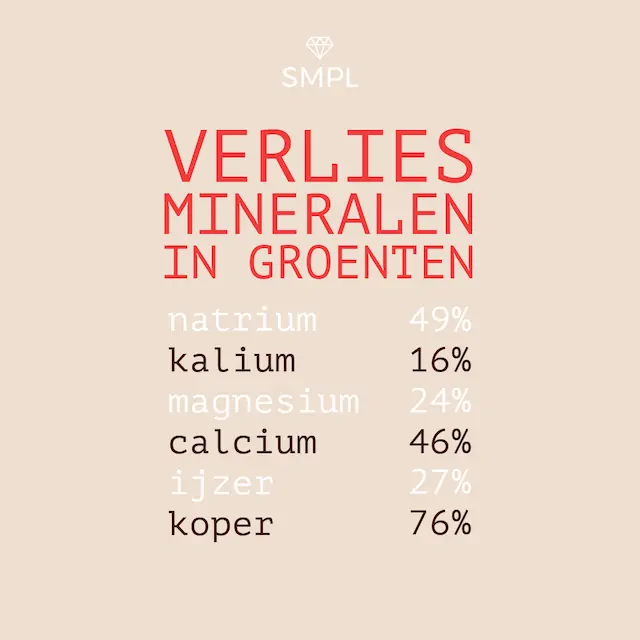
The earth, and more specifically the soil, is the primary source of these minerals. Plants absorb minerals from the ground, and through the food chain, these minerals eventually reach humans. However, due to the intensive agricultural practices of the last century, the mineral content of our farmland has decreased drastically. Studies show that soils worldwide have lost between 72% and 85% of their mineral content, depending on the region.
The consequences of this are alarming. Fruits and vegetables today contain far fewer nutrients than they did a few decades ago. This means that even if we eat healthily, we are not getting the necessary amounts of minerals that are essential for our health. The impact of these mineral deficiencies is widespread and manifests in all kinds of health issues, from a weakened immune system to chronic diseases such as diabetes, cardiovascular disease, and cancer.
"Every disease, every ailment, and every illness can be traced back to a mineral deficiency." - Dr. Linus Pauling, two-time Nobel Prize winner
"The lack of minerals is the root of all disease." - Dr. Gary Price Todd
The depletion of minerals in our soil is a process that began decades ago and has only worsened since. The roots of this problem lie in the way we farm. The rise of large-scale agricultural practices and the growth of agribusiness have led to intensive land cultivation without sufficient attention to maintaining the soil's natural balance. Through chemical fertilizers, pesticides, the use of heavy machinery, and herbicides, the vitality of soil life has been severely disrupted, leaving it unable—or much less able—to produce humic and fulvic acids. It is fulvic acid that is capable of binding to minerals in the soil—the nutrients for plants—and making them bioavailable so the plant can absorb them. Without vital soil life, there is no fulvic acid, and therefore no minerals for plants to absorb. This makes them much more vulnerable to insects, fungi, and weeds, resulting in even more pesticides and even more chemical fertilizers.
The introduction of chemical fertilizers in the early 20th century marked a turning point in agriculture. These fertilizers, consisting of nitrogen, phosphorus, and potassium, were designed to increase crop yields. Although these fertilizers stimulate plants to grow quickly, they contain only a fraction of the minerals naturally present in the soil. This means that while crops may look healthy and grow fast, they lack the full nutritional value they should have. Justus von Liebig, the inventor of chemical fertilizer, realized early on that what he had discovered would lead to misery.
In addition, the large-scale application of pesticides and herbicides has had a devastating effect on soil ecology. These chemicals kill not only pests but also the vital microorganisms in the soil that are essential for converting minerals into forms that can be absorbed by plants. Without these microorganisms, the soil cannot provide plants with the nutrients they need, leading to further soil depletion.
Erosion is another major factor contributing to the depletion of minerals in the soil. Through deforestation, intensive farming, and improper land cultivation, the soil loses its fertile topsoil, which is rich in minerals.

"In the absence of minerals, vitamins have no function. In the absence of vitamins, the system can use minerals, but in the absence of minerals, vitamins are useless." - Dr. Charles North
The consequences of soil depletion are far-reaching and directly impact our health. One of the most concerning aspects of this crisis is the rise in chronic diseases linked to mineral deficiencies.
Magnesium, for example, is a mineral involved in over 300 biochemical reactions in the human body, including the regulation of blood pressure, blood sugar levels, and muscle and nerve function. A magnesium deficiency is associated with an increased risk of cardiovascular disease, diabetes, and stroke. Unfortunately, magnesium is one of the minerals most depleted in our agricultural soil, meaning that many people worldwide are not getting enough of this crucial mineral through their diet.
Another example is selenium, a mineral known for its powerful antioxidant properties and its role in supporting the immune system. Selenium helps the body fight oxidative stress, a major factor in the development of chronic diseases such as cancer. A selenium deficiency has been linked to an increased risk of various types of cancer, including prostate and lung cancer. And heart failure.
Obesity is another major issue linked to mineral deficiencies. Although obesity is often seen as a result of excessive calorie intake and a lack of physical activity, the quality of nutrition also plays a crucial role. When the body does not receive the necessary nutrients, it remains hungry, even after consuming large amounts of food. This can lead to overeating and weight gain. The body craves the minerals it is missing, but instead of consuming foods rich in these nutrients, many people turn to calorie-dense but nutrient-poor food, which further exacerbates the problem.
"Disease does very certainly and cruelly prey upon undernourished and unfit plants, animals, and people. It is a disgrace to science." -
U.S. Senate, 1936, Senate Document 264

Soil depletion is not just a problem of agricultural practices; it is also a consequence of economic priorities focused on profit maximization rather than sustainable development. The modern agricultural sector is dominated by businesses focused on producing as much food as possible at the lowest possible cost. Because we, the consumers, want that. Let's not forget.
We all want cheap food, but that comes at a price. To meet that demand, agribusinesses produce as cheaply as possible, often at the expense of soil quality and nutritional value. It is a vicious cycle: low prices lead to depleted soil and less nutritious food. We cannot blame the companies entirely, because our demand for cheap food drives them to make these choices.
These economic drivers are often supported by government policies and subsidies aimed at promoting high production figures rather than quality and sustainability. Farmers are rewarded for producing large quantities of food, regardless of nutritional value or the impact on the soil. This has led to a system where soil depletion has become the norm, with devastating consequences for public health and the environment.
In addition, globalization plays a role in the crisis. The demand for cheap agricultural products on the global market has forced farmers to increase their production without considering the sustainability of their practices. This has led to a vicious cycle in which soil depletion leads to lower crop yields, which in turn forces farmers to adopt even more intensive methods to make a living.
"It is easier to cure sick soils than sick people—which shall we choose?" - U.S. Senate, 1936, Senate Document 264
The dangers of soil depletion and the resulting mineral deficiency have been known for a long time. In 1936, U.S. Senate Document 264 warned of the serious consequences of the declining fertility of American agricultural soils. The document stated that the soil was so severely depleted that the food grown on it no longer contained enough minerals to keep the population healthy.
Although this warning was given nearly a century ago, the lessons that should have been learned have been largely ignored. Instead of taking action to restore and enrich the soil, policymakers and agribusinesses have focused on increasing food production to feed a growing global population. This has led to a situation where soil worldwide has been further depleted, with disastrous consequences for human and environmental health. No
The 1992 Earth Summit report once again highlighted the severity of the situation. The report showed that the mineral content of agricultural soil worldwide had decreased dramatically, with North America being one of the most affected regions. Nevertheless, little was done to reverse the trend, and the situation has only worsened since then.
"Our immunity runs strongly parallel to the immunity of the earth" - Dr. Bernard Jensen
Although technology and science have enabled us to produce more food than ever before, they have also contributed to the current crisis. The introduction of chemical fertilizers and pesticides was originally seen as a breakthrough that would revolutionize food production. While these technologies have indeed led to higher yields, they have also resulted in severe soil depletion and a decline in the nutritional value of crops.
In addition, genetically modified organisms (GMOs) have further transformed agriculture. While GMOs offer certain benefits, such as increased resistance to diseases and pests, they have also led to monocultures—vast fields with only one crop. These monocultures deplete the soil faster because they extract the same minerals from the ground year after year without replenishing them. Furthermore, the reliance on chemical pesticides and synthetic fertilizers for GMO crops is often higher, which further weakens the soil.
The question arises: can science and technology also help us out of this crisis? The answer is yes, but only if we are willing to think differently about agriculture and food production. Technologies and methods are already available that can help restore and enrich the soil, such as the use of organic fertilizers, agroecological practices, and soil remineralization. These approaches focus on working with nature rather than against it.
"To ensure that man can continue to live on earth, he must make some fundamental changes." - Dr. Maynard Murray
The solution to soil depletion lies in restoring the natural balance of the soil. This means embracing sustainable agricultural practices that focus on maintaining and enriching the soil, rather than depleting it.
One of the most effective ways to restore the soil is through the use of organic fertilizers. These fertilizers are rich in a wide range of minerals and help enrich the soil with the nutrients needed for healthy plant growth. Moreover, organic fertilizers support the activity of microorganisms in the soil, which is essential for the uptake of minerals by plants.
Soil remineralization is another important strategy. This process involves adding minerals, such as clay, rock dust, and seaweed, to the soil to restore its natural balance.
Agroecology is a holistic approach to agriculture that considers the interaction between plants, animals, humans, and their environment. By promoting crop diversity, keeping the soil covered with crop residues, and minimizing the use of chemical pesticides, agroecology can help protect and enrich the soil. This approach has benefits not only for soil fertility but also for biodiversity and the climate resilience of agricultural systems.
"If an element is missing in the soil, it is missing in the food we eat." - Dr. Bernard Jensen
Consumers play a crucial role in addressing the crisis of soil depletion. By making conscious choices about what we eat and where we buy it, we can increase the demand for sustainably produced food and thereby influence agricultural practices.
An important step we as consumers can take is buying organic food. Organically grown food is produced without the use of synthetic pesticides and fertilizers, which is not only better for our health but also for the soil. Although organic food is often more expensive, the long-term benefits are significant. By investing in organic food, consumers support agricultural practices that enrich the soil instead of depleting it.
In addition, consumers can influence the market by choosing locally produced food. Local farmers often have a smaller ecological footprint and are more inclined to use sustainable agricultural practices. By buying locally, consumers can support the demand for healthy, nutritious crops and contribute to soil restoration. And focus on the foundations of health.
"Declining soil fertility produces inferior harvests, resulting in pathogenic conditions in animals and humans." - Dr. William A. Albrecht
The crisis of soil depletion is not just a problem for the agricultural sector; it is an existential threat to the future of humanity. The Earth is a closed system, and the health of the soil is directly linked to the health of humanity. If we continue to deplete the soil, we will be unable to produce enough nutritious food to feed the global population, which will lead to an increase in hunger, disease, and poverty.
In addition, soil depletion also has environmental consequences. Depleted soils are less capable of sequestering carbon, which contributes to climate change. Strangely enough, no one is talking about it.
Furthermore, erosion of depleted soils leads to water pollution and loss of biodiversity, which further disrupts the ecological balance.
The depletion of minerals in our soil is a creeping crisis that threatens the health and survival of humanity. Modern agricultural practices have led to the impoverishment of the soil and a decrease in the nutritional value of our food. This trend must be reversed, and that can only happen through conscious action at all levels of society. By embracing sustainable farming practices, remineralizing the soil, and making conscious choices as consumers, we can repair the damage and secure a healthy future for ourselves and future generations. But time is running out. If we do not act now, we risk losing our most valuable resource: the fertile soil upon which our lives depend. Unfortunately, those who bring this fundamental problem to light—for instance, in American politics—are not taken seriously, and you hear nothing about it in the media.
Or read more:
what used to be in the soil and has now disappeared
and
what is fulvic acid, the mechanism explained.
Sources
Everything you want to know about SMPL72, enrollment, and how it works. Still have questions? We've got the answers.
This varies from person to person and depends primarily on your starting point. Fulvic acid supports the absorption and bioavailability of the minerals you already get through your diet or supplements. The faster your body responds to that improved availability, the sooner you will notice a difference. People with low mineral levels or higher requirements often experience changes sooner than those who are already well-nourished. Some users notice more clarity or a calmer energy level within a few days, while for others, it happens more gradually over a period of weeks. In SMPL72, the fulvic acid is naturally bound to 72 different minerals and trace elements. The most important thing is consistency: fulvic acid doesn't act as a quick stimulant, but as a daily absorption mechanism that builds its effect step by step.
People often get some minerals from various sources, but usually not enough. Furthermore, they are often poorly absorbed by the digestive system. It is important to realize that most supplements are synthetic, and in the case of minerals, they are essentially just rock. These contain large molecules that your body can barely absorb, if at all. We have previously written a blog post about the ins and outs of supplementation; feel free to check out our blog section. You might already be taking magnesium or zinc, but keep in mind that you are only taking one or two of the 60 minerals your body needs every day. When you think in terms of a complementary approach, you cannot simply pick one mineral out of the entire spectrum.
Fulvic acid is not an energy booster, nor is it a substance that provides an immediate effect on fatigue or concentration. What it does is something more fundamental: it supports the way your body absorbs and utilizes minerals. And that very point—the utilization of minerals—plays a bigger role for many people than they realize. Fatigue, "brain fog," and concentration issues often have multiple causes, but in orthomolecular practice, it is frequently observed that mineral metabolism and electrolyte balance are significant factors. Minerals are necessary for processes such as: - signal transmission in the nervous system - energy production in the mitochondria - oxygen transport - fluid balance in and around the cell - enzyme activity involved in focus, alertness, and metabolism If those minerals are insufficiently available at the cellular level, the body cannot perform these processes efficiently. Fulvic acid cannot solve that on its own, but it makes minerals chemically smaller, more soluble, and more accessible to the body. As a result, the minerals you ingest through food or supplements can be better utilized where they are needed. Many users experience a more stable energy level, greater clarity, or fewer fluctuations throughout the day. Not because fulvic acid provides a direct stimulant, but because minerals are able to do their job better. This is a fundamentally different mechanism than that of caffeine, stimulants, or "energy boosters." It remains important to emphasize: fulvic acid is not a treatment for fatigue or concentration issues. It merely supports the biological foundation upon which energy, clarity, and nerve function operate. What an individual notices from it naturally also depends on diet, hydration, lifestyle, and individual needs.
Fulvic acid has a very mild, almost neutral taste. Most people barely notice it when they add a few drops to a glass of water. Some describe it as having a very light mineral flavor, but you usually only notice it if you are really paying attention. SMPL72 is pure fulvic acid with no additives, which keeps the taste soft, clean, and subtle. You don't need to worry about a bitter, sharp, or "muddy" taste, which is common in impure or thick humic products.Most users find that it simply tastes like water with a very faint hint of minerality. This makes it easy to use every day, even for children or people who are sensitive to strong flavors. It is best to take SMPL fulvic acid in a glass of chlorine-free water. Fruit juice is also an option, but avoid hot drinks. It is very easy to use.
Add 7-10 drops daily to a glass of (chlorine-free) water (fruit juice is also an option, but avoid hot drinks). For children: 1 drop per 10 kg of body weight. Feel free to increase the dose during illness or intense physical exertion. For maximum absorption: take 30 minutes before a meal. For an energetic start to the day: take in the morning on an empty stomach. For recovery: take immediately after sports or physical exertion. SMPL72 is a powerful detox, so be sure to drink plenty of water. If you are pregnant or taking medication, build up the dose gradually and monitor how your body reacts. When in doubt, consult your doctor or midwife.


