How fulvic acid improves the absorption of minerals in your body (full explanation)
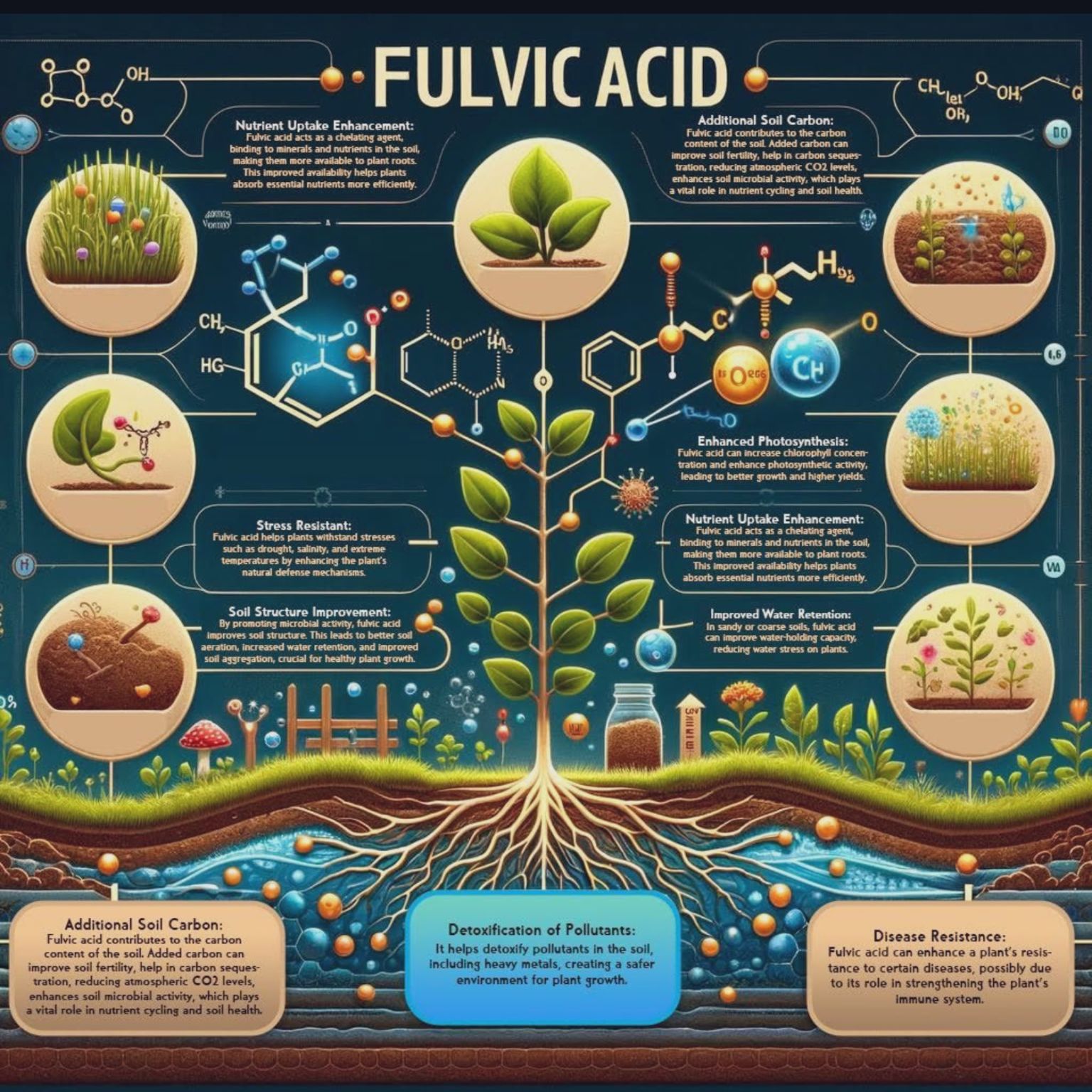
Fulvic acid binds to ionic minerals and helps them through the intestinal and cell walls. This way, it improves the mineral absorption and balance in your body.
Fulvic Acid:
- binds minerals in a biological way,
- makes them smaller, more stable and water-soluble,
- transports them along your intestinal wall,
- brings them through the cell wall,
- increases their bioavailability,
- and keeps the electrolyte balance moving.
Without fulvic acid, you can swallow minerals until you see blue; with fulvic acid, they will finally arrive where you need them: in the cell. Fulvic acid is the body's own mechanism that has almost completely disappeared in the modern food chain.
Introduction: the big misconception about minerals
Ask a hundred people if minerals are important.One hundred say “yes”.
Then ask: do they actually end up in your cells?
Then it stays quiet.
Our health world suffers from milligram thinking: we are blindly staring at amounts, while the real problem is absorption. Not how much goes in, but how much gains. We think more tablets make us healthier. While the real problem is that they arrive nowhere.
You can buy the most expensive magnesium, the most beautiful multivitamin, the most hyped pot of calcium. But if there is no transport mechanism, something that guides, protects, reduces, stabilizes and pushes a mineral through barriers, it's a ride to the toilet bowl.
And this is where fulvic acid comes in.
No supplement.
No hype.
Not a miracle powder.
But one biological transport mechanism that already 33 million years exists.
The origin: why fulvic acid exists in the first place
Fulvic acid is created when plants and microorganisms interact with organic matter for millions of years. It is the final stage of humification: an ancient process that only occurs in rich, living soils.
Fulvic acid is:
- extremely small (the smallest fraction of humic substances),
- fully water-soluble,
- highly reactive,
- negatively charged,
- able to bind positive ions (minerals).
Nature created fulvic acid as a mediator between minerals in the soil and minerals in the plant.
So it doesn't work into the body.
It works as the body.
Minerals: why they're so stubborn without fulvic acid
We often underestimate minerals. They don't act like simple pellets that are easily absorbed. They are charged ions, and charged ions are selective, sensitive, and anything but obvious.
A mineral mYou must:
- have the right size
- the right load
- be in dissolved form
- able to come into contact with transporters
- are compatible with the membrane potential
- and then through a layer of fat: the cell wall.
Here's why many synthetic supplements work so poorly:
- they are too big,
- too unstable,
- not easily soluble,
- lose their load in stomach acid,
- react with other substances,
- and are simply excreted.
Modern man thinks he has “a deficit”.
But in reality, he mainly has a problem with recording.
Exactly what fulvic acid does step by step
1. Fulvic acid binds minerals (chelation, but organic)
This is the first superpower.
Fulvic Acid:
- recognizes minerals,
- binds them to their ionic form,
- stabilizes them in water.
Not in a brutal, synthetic way but like an organic velcro tape.
It binds flexibly.
Also, let go where necessary.
That is why it is safe and body-specific.
“Fulvic acid is not a police officer. It's the neighbor who helps you lift moving boxes and then puts them neatly back down.”
(Orthomolecular detail: this bond makes minerals less likely to form complexes with phytates or oxalates — two huge uptake blockers.)
2. Fulvic acid reduces minerals (ionic cleavage)
A mineral ion that is packed into a large compound does not go anywhere.
Fulvic acid makes them:
- smaller
- finer
- more soluble
This process is called reducing: it breaks down large clumps into micro-ions.
Without this?
Do you mainly have expensive powders with delusions of grandeur.
3. Fulvic acid protects minerals against stomach acid and oxidation
In the stomach is the battlefield.
Acids.
Enzymes.
Oxidative reactions.
Many minerals are already going under here.
Fulvic Acid:
- buffers pH,
- stabilizes ions,
- prevents them from hitting.
As a result, minerals arrive in the small intestine in a form that the body wants to absorb.
4. Fulvic acid transports minerals through the intestinal wall
A mineral must pass through enterocytes. These are your “uptake muscles” in the small intestine. They determine what is allowed and what is not allowed into your body. This only works if:
- it's the right size
- it's electrically correct
- and it is stable in solution
Fulvic acid controls this like a sling:
- it holds the ion
- brings it to the membrane
- and delivers it into the bloodstream.
That is why fulvic acid is often called a 'carrier' mentioned.
5. Fulvic acid brings minerals through the cell wall
The cell wall is a fat barrier. Water-soluble ions are usually either difficult or impossible to get through.
Fulvic Acid:
- is extremely small
- is water-soluble
- has a negative charge
- forms temporary complexes with minerals,
- and can therefore enter via diffusion and transport ports.
It's like the cell says:”Fulvic acid? Oh, come on in, dude. You can go on.”
6. Fulvic acid increases bioavailability
Bioavailability means “What can your body really use?”
This is the real measure. Not how many mg is on the label.
Fulvic acid increases this availability by:
- better solubility,
- better load,
- better membrane transport,
- better intracellular delivery,
- better distribution to organs.
Why our modern world needs fulvic acid so much
Two reasons.
1. Our soil contains hardly any fulvic acid
Tractors became heavier. Fertilizer replaced soil life.Pesticides killed microbes.
The humus fraction, where fulvic acid comes from, fell dramatically.
What does that mean?
We eat foods that:
- contains fewer minerals
- contains fewer transport mechanisms
- contains fewer bioactive compounds
Modern man eats high-calorie, but low-mineral foods.
2. Our stress, lifestyle and medication increase our needs
Minerals are depleted more quickly due to:
- stress
- caffeine
- alcohol
- high insulin
- bad sleep
- medication use
- exercise intensively
So we need more... but take up less. Fulvic acid does not exactly supplement the minerals.
It only ensures that what you ingest is used as intended.
Slot: nature already knew this
Before the first humans took a supplement, before magnesium citrate became a marketing term, before the wellness industry invented 812 variants of electrolyte powder, nature already used fulvic acid to get minerals from the soil to the plant.
Man is simply built on the same system. We just forgot about it.
Nature laughs to herself. For millennia, she did well. It wasn't until we started 'optimizing' it that things went wrong. SMPL72 Fulvic Acid brings nature's logic back to a body that yearns for simplicity.