Supplements
Nutritional supplements, why do you need them?
Discover how SMPL72 Fulvic Acid helps replenish minerals, supports all body systems, and provides natural detoxification in a toxic world.

Discover how SMPL72 Fulvic Acid helps replenish minerals, supports all body systems, and provides natural detoxification in a toxic world.
"Mineral or trace element deficiencies are virtually non-existent in Western society, unless there are unbalanced eating habits, long-term illness, or chronic medication use."
So states the Netherlands Nutrition Centre (Voedingscentrum) on their website.
These risk groups combined—the chronically ill and those with unbalanced diets—already account for millions of people.
So, taking this lightly, as the Nutrition Centre does, is unjustified. It is somewhat more complex. A simple, yet long story.
Why should you take nutritional supplements?
The answer to this question is twofold: on one hand, the burden on our bodies due to stress, smoking, pollution, particulate matter, synthetic nutrients and additives, pesticides, and medication use has increased enormously in recent decades. On the other hand, the quality of our food has deteriorated dramatically during that same period. We are caught in a double bind, and it is becoming practically impossible to do anything about it in a normal way—by going to the store and preparing your own meals.
While we are all living longer, the number of years we live in good health is decreasing. In other words, we are growing old in a frail state, not to mention the suffering many must endure in their later years before they eventually pass away. According to Statistics Netherlands (CBS), compared to 35 years ago, the expected number of healthy life years for a boy or girl born today has decreased by 7.7 and 13.1 years, respectively.
Figures from Statistics Netherlands (CBS)
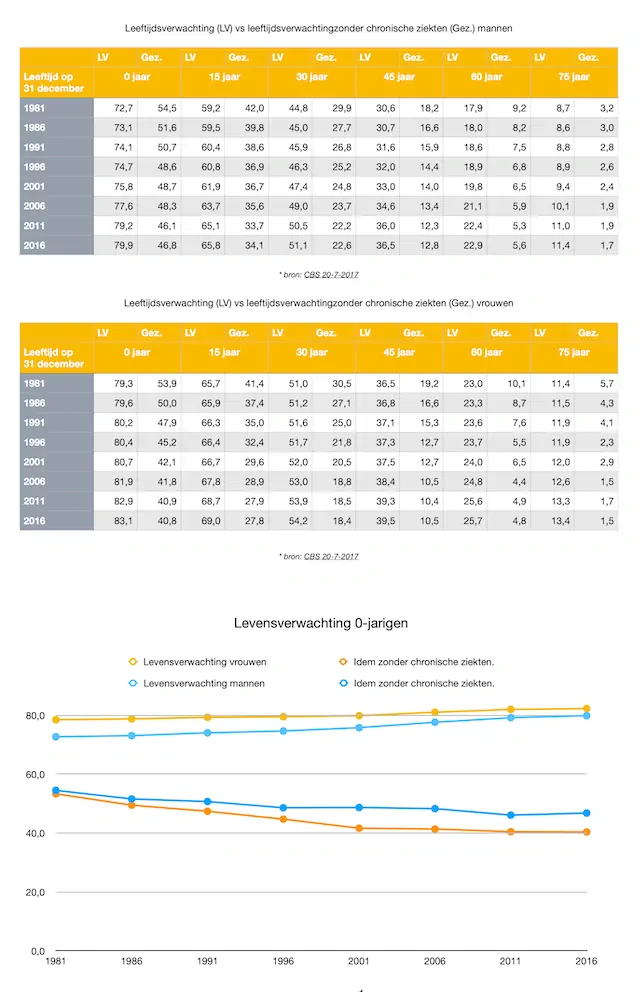
For women, this means they are expected to be chronically ill for more than half of their lives.
This shocking reality is also reflected in other figures.
In the Netherlands, just over 5 million people currently suffer from some form of chronic illness. That is nearly one-third of the population, and it is likely not much different in other Western countries. We accept this as "normal." Taking a pill is very common. For high blood pressure, for your cholesterol, for your diabetes, for sleep, for pain, for your depression.
This trend of an increasingly unhealthy population will only continue. A disturbing prospect. Especially since the costs involved will spiral completely out of control. Healthcare as we know it today is becoming unaffordable.
According to the 2018 Public Health Future Exploration trend scenario, commissioned by the RIVM, healthcare costs are expected to double by 2040 to an unprecedented €174 billion.
Per capita, healthcare spending will rise from €5,100 to €9,600 by 2040.
It is clear that to reverse this trend, the focus must shift from treating symptoms to prevention through a healthy lifestyle. Less smoking, less stress, more exercise, and better nutrition is the advice.
Let's dive a little deeper.
There are two major trends that determine our health: the increasing burden on our bodies and the inflation of our food.
Free radicals attack our cells. It is like rust on the cells.
And as a result, cells become inflamed.
In itself, this is a normal phenomenon, and a healthy body with a healthy immune system knows how to resolve this low-grade inflammation at an early stage. If, on the one hand, the immune system becomes weakened by a lack of nutrients and, on the other hand, the number of free radicals increases due to stress and toxic pollution, there comes a point where the body is no longer able to stop the inflammation in time or effectively. Scientists agree that this inflammation is a precursor to (chronic) diseases.
It is interesting to note that you barely notice these inflammatory processes until it is too late. Everyone knows examples of people who have always felt fine, go to the doctor one day because they suddenly don't feel well, and are then told they only have a few months to live.
Our bodies are increasingly burdened, a trend that has been ongoing for decades. It starts with our hectic lives full of stress.
We have become so accustomed to it that we no longer notice it.
Just like a fish in murky water that no longer realizes it is swimming in murky water. It is therefore difficult to express in numbers, but I think everyone can see that compared to 50 years ago, the
amount of stress in our lives has increased enormously. More and more people are experiencing burnout at an increasingly younger age. It is starting to take on almost epidemic proportions.
Stress is very taxing on the body. As a result of stress, large amounts of free radicals are produced in the body, which can damage cells and lead to low-grade (cellular) inflammation.
Since the rapid rise of the chemical industry about 100 years ago, our environment has slowly but surely become polluted with residues of an endless array of toxic substances that are difficult or impossible to break down.
It is unclear what the actual figures are. According to a list from the American TSCA, about 85,000 chemicals have appeared on the market since 1979. Not all of them are still available, so the actual number is lower, but no one knows for sure.
However, these numbers pale in comparison to the list maintained by the American Chemical Society. They register 12,000 (!) new chemical substances daily, and according to their data, there are more than
45 million (!) commercially available chemicals worldwide.
Because we humans are at the top of the food chain, these substances slowly but surely accumulate in our bodies.
Of particular concern are substances that act like hormones in our bodies. And, of course, those produced in large volumes that we encounter in our daily lives.
You might wonder, aren't these substances tested?
Substances used in medicines are tested very extensively before they are allowed on the market. This also applies, to a lesser extent, to substances intended for human consumption.
However, substances used for other purposes are tested much less rigorously. Many of these end up in our lives, only for us to conclude later that they aren't as safe for humans as we thought. This is a major problem, especially because the tests currently used are not effective for substances that mimic hormone activity. It is even questionable whether these substances can be reliably tested in any practical sense.
There is no denying that we live in a toxic world, and precisely because humans are at the top of the food chain, residues of these chemical substances slowly but surely work their way up the chain and eventually accumulate in the human body, such as:
When you think about it, it is madness to consciously inhale highly toxic substances in concentrations that make everything else pale in comparison. It has been calculated that in the Netherlands, 20(!) hospitals could be closed if everyone stopped smoking. Nothing has as great an impact on health as smoking.
And not just for the smokers themselves, but for everyone who—willingly or not—is exposed to secondhand smoke.
The active ingredients in medicines are by definition toxic and come with a list of side effects that is often much longer than the condition the drug was originally designed to treat.
Medicines, with all their limitations, are important inventions that can be life-saving in acute situations. However, whether they also offer a solution for long-term chronic illnesses is a subject of lively debate.
Taking medication daily for the rest of your life carries significant risks with consequences that are difficult to foresee. And that is not even considering the potential interactions between different medications. It is a fact that every year a significant number of patients die as a result of medication use, and an even larger number become seriously ill from it.
The problem is that pharmaceutical companies find it very difficult to predict how medicines metabolize in the human body—or, in other words, how foreign substances are converted into substances the body can process.
After all, while the design of the body is the same for everyone, the state it is in varies from person to person.
If a medicine does not metabolize well or at all, the body may suddenly view these substances as life-threatening rather than life-saving, which can trigger a severe immune response with all the associated health risks.
These are widely used in intensive agriculture and horticulture to protect crops against insects and weeds.
The Greek suffix -cide means to kill. In other words, we are dealing with poison. If something is toxic to insects and plants, are they also toxic to humans?
Residues of these substances enter our lives directly or indirectly. Perhaps the amounts are so small that toxicologists say they do little harm (which is what you often hear). But because these substances accumulate in the human body over the long term, it is quite possible that, according to those same toxicological standards, they eventually become harmful.
Regardless, they remain toxic substances that can damage our cells, just as they do the cells of plants and insects.
According to toxicologists, all these substances are not dangerous because the quantities in which they are used are too low to be harmful. In other words: no irrefutable and direct (or, to use a fancy word, causal) link can be established between these substances and an unnatural death.
However, what is conveniently forgotten are the long-term consequences of prolonged exposure to these seemingly harmless substances and the effects they have on each other and the human body. The accumulation of all these substances and their long-term use.
Policymakers do not take this into account for the simple reason that there are no practically feasible measurement methods.
But just because something cannot be measured does not mean it does not exist.
It happens gradually, which is why it goes largely unnoticed, but the quality of our food has declined enormously over the past few decades. In other words: we are getting fewer and fewer essential nutrients—substances the body needs to function optimally. What we consume today is a fraction of what was in our food fifty years ago.
If you stop to think about it, it is not hard to realize that the human body is an incredibly complex machine, compared to which every human invention pales into insignificance. The gut contains more (highly necessary) bacteria than there are stars in the Milky Way. New scientific research shows that those who have the wrong bacteria in their gut gain weight more easily. But humans are not helpless victims of their bacteria.
We can influence which bacteria get to call the shots in our gut, for example by avoiding antibiotics and smoking. And by eating well, for instance :) We should be grateful for the discovery of DNA. But the different lengths and combinations run into the thousands of billions of possible variations—perhaps almost as many as there are stars.
Although science now knows a great deal about the human body, there is still so much more that we have no idea about.
Science struggles to scientifically prove even the simplest principles of nutrition. That is because food is so much more than the sum of its parts—the individual chemical compounds.
All these substances work together synergistically and all influence one another. Compare it to a Mozart symphony: you have the different instruments, each with its own sound, the scores consisting of individual notes, and so on.
When everything works together well, it becomes pleasant to listen to and can even transport you. In other words, one note does not make a symphony. Far from it, in fact. Everyone understands that.
And it is the same with nutrition.
A single compound that a biochemist has managed to isolate and replicate from a plant is, of course, not the same as the far more complex original, let alone the entire plant. It makes sense, doesn't it? Unfortunately, food industry marketing and science lead us to believe it is exactly the same.
Your body knows better!
Your body is like a highly precise machine capable of incredible performance, but only if it receives the right substances in the right amounts. And the more it is put under stress, the more critical that becomes.
Just like a Formula 1 race car. You wouldn't put regular gasoline and hardware-store motor oil in one of those. The engine wouldn't even start.
In comparison, the remarkable thing about the human body is that it can endure a great deal before it gives up.
This demonstrates both its strength and its weakness.
Because by the time it gives up, it is usually too late. People who haven't learned to listen to their bodies will easily ignore the warning signs and run themselves into the ground. There is nothing left in the tank.
Your body needs these substances, so if they are no longer sufficiently present in our food, you can imagine that this leads to problems. And that is exactly what is happening on an increasingly large scale. Since the Second World War, intensive agriculture using synthetic fertilizers has managed to boost crop production enormously.
Yields per hectare are unprecedented. But at what cost? Due to the intensification of agriculture, the soil has become depleted. I look forward to writing more about this next time.
Many trace elements and minerals that can only enter our bodies through plants are simply no longer in the soil.
The constant push for higher production has led to a massive increase in the quantity of our crop yields, while their nutritional quality has declined proportionally.
Techniques are also used to extend the shelf life of fruits and vegetables for transport and storage.
For example, bananas are picked unripe, kept in cold storage in large warehouses, and only artificially ripened once an order is received. As a result, many valuable nutrients are lost compared to bananas that have ripened on the tree.
All of this has led to a massive improvement in food distribution over the years, giving everyone in Western countries access to affordable fruits and vegetables.
While fifty years ago we only ate seasonal crops, today's consumer has year-round access to every imaginable fruit or vegetable from around the world. On the surface, it seems we have made enormous progress in prosperity, but appearances are deceiving. While everyone can now buy beautiful, perfect-looking fruits and vegetables for very little, they unfortunately contain very little of value. It is all more filling than nutrition.
Geigy, a Swiss pharmaceutical company, conducted research into the nutritional values of fruits and vegetables in 1985, 1996, and 2002. The results showed that these values have declined dramatically. Keep in mind that another 16 years have passed since then….

The food processing industry has also contributed its share to this decline. Encouraged by consumers who no longer have the time, inclination, and/or skills to prepare their own food, the industry has developed a wide range of ready-made meals and semi-finished products. After all, convenience is king, isn't it?
What consumers fail to realize is that industrial food preparation bears no resemblance to cooking in a regular home kitchen.
For starters, it takes place at much higher temperatures and under much higher pressure than you are used to at home, with the result that the already low nutritional value declines even further.
And as a result of these high temperatures and pressures, all sorts of complications arise that must be countered with what are known as food technologies. In other words, all kinds of exotic chemicals are added to keep the production process efficient—and therefore cheap—and to convincingly spruce up the tasteless and grey-looking end products so that the consumer gets the impression they are eating something comparable to what they could have prepared in their own kitchen.
In the pursuit of profit maximization, all sorts of very cheap-to-produce synthetic ingredients are added to replace much more expensive natural ingredients, the use of which also leads to fewer complications in the production process.
Very convenient for the producer, but what the consumer gains from it remains a moral question. In the best-case scenario, the body cannot do anything with it; in the worst-case scenario, it is downright harmful. In all cases, it contributes absolutely nothing to the nutritional quality of what is being offered—quite the contrary.
In short: the consumer is being completely fooled.
Unfortunately, a large portion of these ingredients do not have to be listed on the packaging. That is how it is regulated by law.
The industry has, of course, worked very hard to ensure this and has convinced legislators that these chemicals pose no threat to public health. Even though there is no idea what effects all these substances have on each other and what the long-term consequences will be.
In summary, several causes can be identified that contribute to this decline:
I realize this is a long piece.
And you are no closer to the solution.
Simply stating that supplements are unnecessary, as the Netherlands Nutrition Centre casually does, is an unjustified conclusion.
But the real answer is, of course, nutrition as Mother Nature intended. Then you wouldn't have to worry at all about whether you're getting everything you need. And you wouldn't have to take any nutritional supplements. It should be that simple, but unfortunately, it no longer is. This is due to the way agriculture has been practiced for hundreds of years, which has accelerated over the last 60 years due to mechanization and artificial fertilizers. This method of farming means that all-important minerals are no longer in the soil and, therefore, no longer in our food.
As a result, crops are weaker and susceptible to diseases and insects, and they contain little nutritional value. This, in turn, leads to the excessive use of pesticides. These crops then have to be "pimped" in a factory to make them taste like something. With—you guessed it—chemicals.
And that leads to a situation where people do not get enough nutrients. The shortage of minerals, in particular, is a major problem. Chronic deficiencies lead to chronic diseases.
The real answer, therefore, is agricultural reform where soil vitality is the starting point. Crops are only as good as the soil they grow in. It will take a while before all farmers start treating the soil more intelligently. Fortunately, there is already a growing number of pioneers who are farming in a fundamentally different way. And we are going to help them! But that is a long-term goal.
But we are also realistic. And for the short term, we therefore recommend one nutritional supplement: SMPL72. From SMPL, of course. It contains all 72 minerals that a human needs and much more. 100% natural. No nonsense.
Everything you want to know about SMPL72, enrollment, and how it works. Still have questions? We've got the answers.
This varies from person to person and depends primarily on your starting point. Fulvic acid supports the absorption and bioavailability of the minerals you already get through your diet or supplements. The faster your body responds to that improved availability, the sooner you will notice a difference. People with low mineral levels or higher requirements often experience changes sooner than those who are already well-nourished. Some users notice more clarity or a calmer energy level within a few days, while for others, it happens more gradually over a period of weeks. In SMPL72, the fulvic acid is naturally bound to 72 different minerals and trace elements. The most important thing is consistency: fulvic acid doesn't act as a quick stimulant, but as a daily absorption mechanism that builds its effect step by step.
People often get some minerals from various sources, but usually not enough. Furthermore, they are often poorly absorbed by the digestive system. It is important to realize that most supplements are synthetic, and in the case of minerals, they are essentially just rock. These contain large molecules that your body can barely absorb, if at all. We have previously written a blog post about the ins and outs of supplementation; feel free to check out our blog section. You might already be taking magnesium or zinc, but keep in mind that you are only taking one or two of the 60 minerals your body needs every day. When you think in terms of a complementary approach, you cannot simply pick one mineral out of the entire spectrum.
Fulvic acid is not an energy booster, nor is it a substance that provides an immediate effect on fatigue or concentration. What it does is something more fundamental: it supports the way your body absorbs and utilizes minerals. And that very point—the utilization of minerals—plays a bigger role for many people than they realize. Fatigue, "brain fog," and concentration issues often have multiple causes, but in orthomolecular practice, it is frequently observed that mineral metabolism and electrolyte balance are significant factors. Minerals are necessary for processes such as: - signal transmission in the nervous system - energy production in the mitochondria - oxygen transport - fluid balance in and around the cell - enzyme activity involved in focus, alertness, and metabolism If those minerals are insufficiently available at the cellular level, the body cannot perform these processes efficiently. Fulvic acid cannot solve that on its own, but it makes minerals chemically smaller, more soluble, and more accessible to the body. As a result, the minerals you ingest through food or supplements can be better utilized where they are needed. Many users experience a more stable energy level, greater clarity, or fewer fluctuations throughout the day. Not because fulvic acid provides a direct stimulant, but because minerals are able to do their job better. This is a fundamentally different mechanism than that of caffeine, stimulants, or "energy boosters." It remains important to emphasize: fulvic acid is not a treatment for fatigue or concentration issues. It merely supports the biological foundation upon which energy, clarity, and nerve function operate. What an individual notices from it naturally also depends on diet, hydration, lifestyle, and individual needs.
Fulvic acid has a very mild, almost neutral taste. Most people barely notice it when they add a few drops to a glass of water. Some describe it as having a very light mineral flavor, but you usually only notice it if you are really paying attention. SMPL72 is pure fulvic acid with no additives, which keeps the taste soft, clean, and subtle. You don't need to worry about a bitter, sharp, or "muddy" taste, which is common in impure or thick humic products.Most users find that it simply tastes like water with a very faint hint of minerality. This makes it easy to use every day, even for children or people who are sensitive to strong flavors. It is best to take SMPL fulvic acid in a glass of chlorine-free water. Fruit juice is also an option, but avoid hot drinks. It is very easy to use.
Add 7-10 drops daily to a glass of (chlorine-free) water (fruit juice is also an option, but avoid hot drinks). For children: 1 drop per 10 kg of body weight. Feel free to increase the dose during illness or intense physical exertion. For maximum absorption: take 30 minutes before a meal. For an energetic start to the day: take in the morning on an empty stomach. For recovery: take immediately after sports or physical exertion. SMPL72 is a powerful detox, so be sure to drink plenty of water. If you are pregnant or taking medication, build up the dose gradually and monitor how your body reacts. When in doubt, consult your doctor or midwife.


