Supplements
Why you need nutritional supplements
Why ultra-processed food is dangerous. And how inflammation threatens our immune system. Discover how you can live a healthier life by avoiding processed foods.
Why ultra-processed food is dangerous. And how inflammation threatens our immune system. Discover how you can live a healthier life by avoiding processed foods.
On January 1, 2019, the Netherlands faced a shocking health problem: no fewer than 10 million people, amounting to 60% of the population, suffered from a chronic illness (https://www.vzinfo.nl/chronische-aandoeniningen-en-multimorbiditeit.. But nutritional supplements aren't necessary?

Moreover, it is estimated that 40% (!) of Dutch elderly people in care homes are malnourished, which is alarming in itself and has drawn the attention of the Kenniscentrum Ondervoeding. https://www.kenniscentrumondervoeding.nl)

These figures raise the question: is our body sufficiently nourished to provide a strong defense against disease? According to some, nutrition doesn't seem to play as crucial a role as it appears, but history suggests otherwise.
Scurvy in sailors? Oh right, vitamin C.
Rickets? Oh right, sunlight and vitamin D.
Beriberi? Oh right, vitamin B1.
It is clear that our body needs sufficient nutrients to stay healthy, as the Voedingscentrum also states, but what about the current situation?
“A deficiency in minerals or trace elements hardly occurs in Western society anymore, unless there are one-sided eating habits, long-term illness, or chronic medication use," according to the Voedingscentrum. “Eating a varied diet according to the Guidelines for Good Nutrition provides almost everyone with sufficient vitamins, minerals, and trace elements. For some population groups, this may not be the case. They are advised to use a supplement. This concerns specific advice for babies (vitamins D and K), young children (vitamin D), women trying to conceive (folic acid) and during pregnancy (vitamin D and folic acid), the elderly (vitamin D), people with dark or tanned skin or those who do not get outside enough (vitamin D), and people who do not consume animal products (vitamin B12).”
The groups susceptible to deficiencies in essential nutrients, such as minerals and trace elements, is much larger than many think. It is not just about the groups mentioned above, but also people with one-sided eating habits, the chronically ill, and even people who appear to eat healthily.
Added together, that amounts to millions of people. The Voedingscentrum seems to be underestimating the severity of the problem.
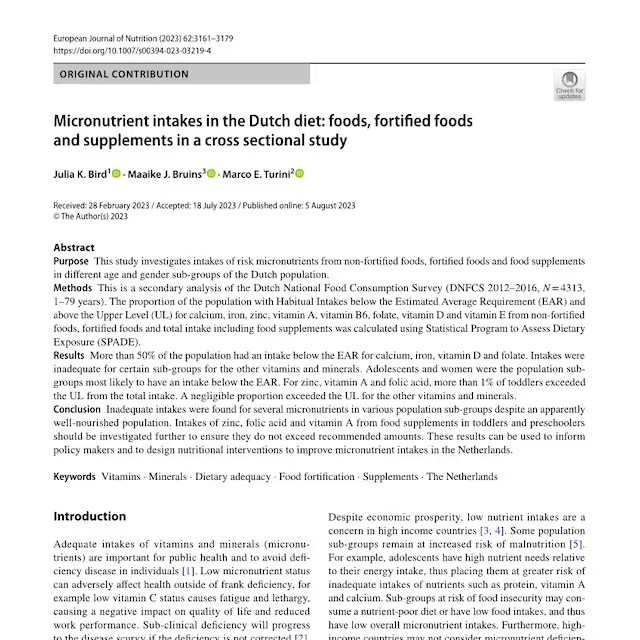
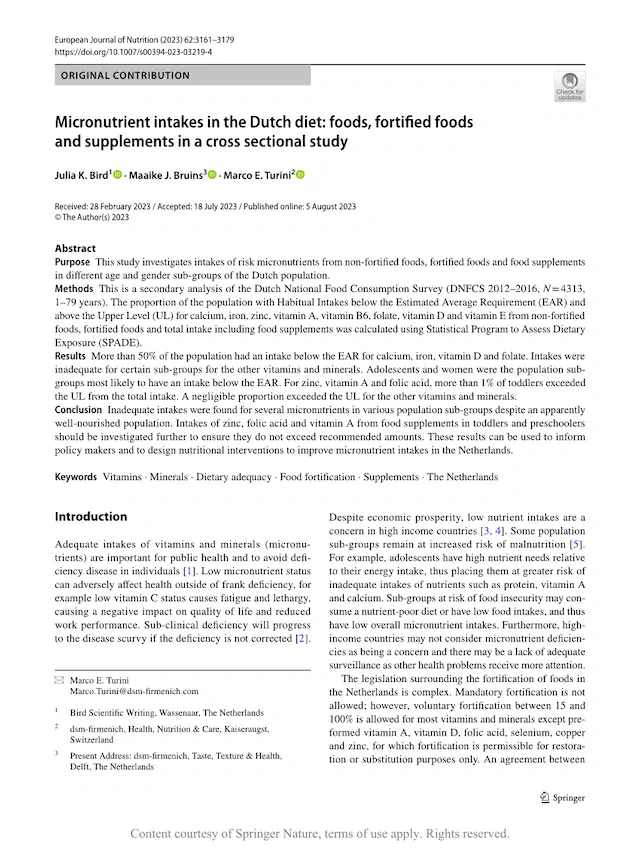
New research in The European Journal of Nutrition published in August 2023 (https://www.researchgate.net/publication/372940199_Micronutrient_intakes_in_the_Dutch_diet_foods_fortified_foods_and_supplements_in_a_cross_sectional_studyclearly shows that half of the Dutch population does not get enough calcium and iron. Also, zinc, vitamin A, D, and folic acidare problematic.
We are very curious to see how the Netherlands Nutrition Centre views this. And especially Renze. Or Lubach.
The situation is more complex than it seems at first glance.
What is the cause?The answer to this question is twofold: on one hand, the burden on our bodies due to stress, smoking, pollution, particulate matter, synthetic nutrients and additives, pesticides, and medication use has increased enormously over the last few decades. On the other hand, the quality of our food—the nutritional value of our food—has declined dramatically during that same period. We are caught in a pincer movement, and it is becoming practically impossible to do anything about this in a normal way—by going to the store and preparing your own meals.

But how does that work? We’re all getting older, aren't we? Yes, we aWe are certainly living longer, but the number of years we live in good health is steadily declining..According to Statistics Netherlands (CBS), compared to 35 years ago, the expected number of healthy years of life for a boy or girl born today has decreased by 7.7 and 13.1 years, respectively. For women, this means they are expected to live with a chronic illness for more than half of their lives. Taking a pill has become completely normal. For high blood pressure, for cholesterol, for diabetes, for the thyroid, for sleep, for pain, for depression. You name it.
Unaffordable
This trend of an increasingly unhealthy population will only continue. It is a worrying prospect, especially since the associated costs are set to spiral out of control. Healthcare as we know it is becoming unaffordable.
According to the 2018 Public Health Foresight trend scenario commissioned by the RIVM, healthcare costs are set to double by 2040 to an unprecedented €174 billion. Per capita, healthcare spending will rise from €5,100 to €9,600 by 2040.
It is clear that to reverse this trend, the focus must shift from symptom management to prevention through a healthy lifestyle.
Smoking less, reducing stress, exercising more, and...better nutrition is the advice. But how, dear Nutrition Centre, when we are dealing with depleted soil, eating processed food full of chemicals, and healthy food is more expensive than cheap alternatives?
One of the factors threatening our health is the toxins we are exposed to daily. These poisons, such as those found in cigarette smoke, medication, pesticides, air pollution, and even in our drinking water and food, gradually accumulate in our bodies. They can lead to inflammation at a cellular level, which in turn are the precursors to chronic diseases. What makes this inflammation particularly dangerous is that it often goes unnoticed until it is too late. Many people only experience symptoms when they are already seriously ill.
The food processing industry has also contributed to this decline. Encouraged by consumers who no longer have the time, inclination, and/or skills to prepare their own food, the industry has developed a wide range of ready-made meals and semi-finished products. After all, convenience is king, isn't it?
What consumers don't realize is that industrial food preparation bears no resemblance to cooking in a regular home kitchen.
For starters, it happens at much higher temperatures and under much higher pressure than you are used to at home, with the result that the already low nutritional value is further diminished.
These high temperatures and pressures lead to various complications that must be managed through what are known as food technologies. In other words, all sorts of exotic chemicals are added to keep the production process efficient—and therefore cheap—and to convincingly spruce up bland, grey-looking end products so that the consumer feels they are eating something comparable to what they could have prepared in their own kitchen.
In the pursuit of profit maximization, all kinds of very cheap synthetic ingredients are added to replace much more expensive natural ones, which also cause fewer complications during the production process. Very convenient for the manufacturer, but whether it benefits the consumer is a moral question. In the best-case scenario, the body simply cannot process them; in the worst-case scenario, they are outright harmful. In any case, it contributes nothing to the nutritional quality of the product—quite the contrary.
Unfortunately, a large portion of these ingredients do not have to be listed on the packaging. The food industry has, of course, worked very hard to convince lawmakers that these chemicals pose no threat to public health, even though there is no clear understanding of how all these substances interact or what the long-term consequences will be. Joanna Blythman is one of the investigative journalists writing about this; she has gone undercover within the food industry.

In summary, several factors contribute to this decline in the quality of our food:
In a society where 60% of the population suffers from chronic illnesses and 40% of the elderly in nursing homes are considered malnourished, the argument for the importance of nutrition and dietary supplements seems stronger than ever. It would be great if there were a real public debate on the talk shows.
#immunesystem #healthyaging #ultraprocessedfood #processedfood #fulvicacid #healthylifestyle #healthylivingtip #bodyinflammation
Everything you want to know about SMPL72, enrollment, and how it works. Still have questions? We've got the answers.
This varies from person to person and depends primarily on your starting point. Fulvic acid supports the absorption and bioavailability of the minerals you already get through your diet or supplements. The faster your body responds to that improved availability, the sooner you will notice a difference. People with low mineral levels or higher requirements often experience changes sooner than those who are already well-nourished. Some users notice more clarity or a calmer energy level within a few days, while for others, it happens more gradually over a period of weeks. In SMPL72, the fulvic acid is naturally bound to 72 different minerals and trace elements. The most important thing is consistency: fulvic acid doesn't act as a quick stimulant, but as a daily absorption mechanism that builds its effect step by step.
People often get some minerals from various sources, but usually not enough. Furthermore, they are often poorly absorbed by the digestive system. It is important to realize that most supplements are synthetic, and in the case of minerals, they are essentially just rock. These contain large molecules that your body can barely absorb, if at all. We have previously written a blog post about the ins and outs of supplementation; feel free to check out our blog section. You might already be taking magnesium or zinc, but keep in mind that you are only taking one or two of the 60 minerals your body needs every day. When you think in terms of a complementary approach, you cannot simply pick one mineral out of the entire spectrum.
Fulvic acid is not an energy booster, nor is it a substance that provides an immediate effect on fatigue or concentration. What it does is something more fundamental: it supports the way your body absorbs and utilizes minerals. And that very point—the utilization of minerals—plays a bigger role for many people than they realize. Fatigue, "brain fog," and concentration issues often have multiple causes, but in orthomolecular practice, it is frequently observed that mineral metabolism and electrolyte balance are significant factors. Minerals are necessary for processes such as: - signal transmission in the nervous system - energy production in the mitochondria - oxygen transport - fluid balance in and around the cell - enzyme activity involved in focus, alertness, and metabolism If those minerals are insufficiently available at the cellular level, the body cannot perform these processes efficiently. Fulvic acid cannot solve that on its own, but it makes minerals chemically smaller, more soluble, and more accessible to the body. As a result, the minerals you ingest through food or supplements can be better utilized where they are needed. Many users experience a more stable energy level, greater clarity, or fewer fluctuations throughout the day. Not because fulvic acid provides a direct stimulant, but because minerals are able to do their job better. This is a fundamentally different mechanism than that of caffeine, stimulants, or "energy boosters." It remains important to emphasize: fulvic acid is not a treatment for fatigue or concentration issues. It merely supports the biological foundation upon which energy, clarity, and nerve function operate. What an individual notices from it naturally also depends on diet, hydration, lifestyle, and individual needs.
Fulvic acid has a very mild, almost neutral taste. Most people barely notice it when they add a few drops to a glass of water. Some describe it as having a very light mineral flavor, but you usually only notice it if you are really paying attention. SMPL72 is pure fulvic acid with no additives, which keeps the taste soft, clean, and subtle. You don't need to worry about a bitter, sharp, or "muddy" taste, which is common in impure or thick humic products.Most users find that it simply tastes like water with a very faint hint of minerality. This makes it easy to use every day, even for children or people who are sensitive to strong flavors. It is best to take SMPL fulvic acid in a glass of chlorine-free water. Fruit juice is also an option, but avoid hot drinks. It is very easy to use.
Add 7-10 drops daily to a glass of (chlorine-free) water (fruit juice is also an option, but avoid hot drinks). For children: 1 drop per 10 kg of body weight. Feel free to increase the dose during illness or intense physical exertion. For maximum absorption: take 30 minutes before a meal. For an energetic start to the day: take in the morning on an empty stomach. For recovery: take immediately after sports or physical exertion. SMPL72 is a powerful detox, so be sure to drink plenty of water. If you are pregnant or taking medication, build up the dose gradually and monitor how your body reacts. When in doubt, consult your doctor or midwife.


